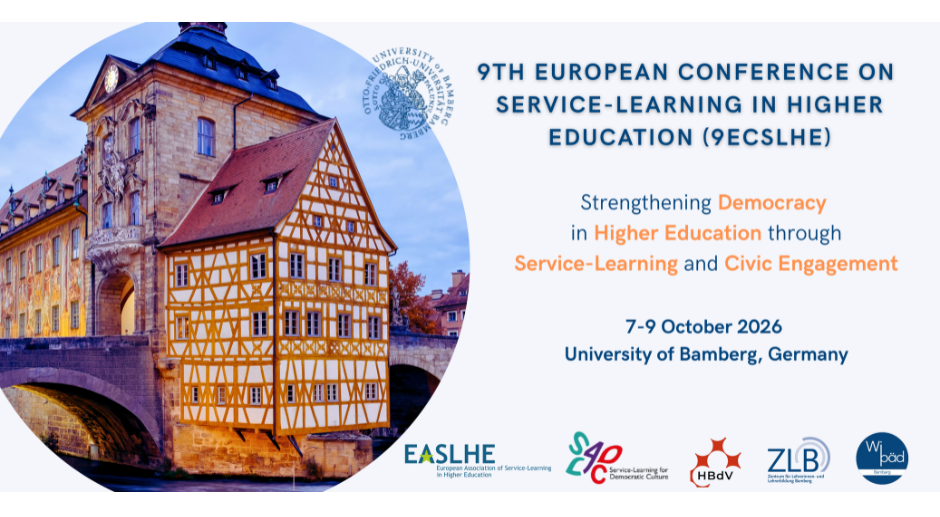
Strengthening Democracy
in Higher Education through
Service-Learning and Civic Engagement
7-9 October 2026 - University of Bamberg, Germany
In an era marked by increasing social polarization and challenges to democratic institutions, higher education must reclaim its role as an agent for civic responsibility and democratic innovation. In 2023, the Council of Europe observed that while its Reference Framework of Competences for Democratic Culture (RFCDC) had made significant progress, more work needed to be done. The Council noted the difficulties in measuring learners’ competences that would promote democratic culture. It furthermore found that integrating competences for democratic culture in academic disciplines had met ‘challenges’ and even ‘resistance’. They concluded that ‘teachers, trainers and lecturers lack the training, support and resources to effectively integrate the RFCDC’.
Service-learning offers a powerful pedagogical framework that can bridge the gap between academic theory and the pressing needs of our communities. Previous research suggests that service-learning may foster capabilities such as critical thinking, empathy, and civic agency. However, the conceptual relationship between these capabilities and established frameworks of competences for democratic culture remains insufficiently specified, and empirical evidence regarding the extent to which service-learning contributes to the development of such competences is still fragmented. This raises the question of how service-learning theories and practices can be more clearly theorized and empirically grounded to contribute to the strengthening of democratic culture and resilient democratic societies.
This conference is an opportunity for us to learn from each other about how service-learning has incorporated democratic competences, through reflective practice or more academic strategies. It gives us a place to share with each other about the opportunities and challenges in promoting such competencies in the classroom, in institutions of higher education, and among social partners. In doing so, the conference seeks to enable all participants in service-learning to more fruitfully become active citizens and co-creators of a more democratic society. The conference seeks to support participants in becoming active citizens and co-creators of democratic societies. It provides a space for reflection, dialogue, and collaboration.
EASLHE and the University of Bamberg, in cooperation with the higher education network ‘Education through Social Responsibility’ and the Erasmus+ project SL4DC, invite academics, teachers, practitioners and community partners engaged in or interested in service-learning and civic engagement to contribute to our conversation on ‘Strengthening Democracy through Service-Learning’
Want to contribute? Submit your paper, poster or workshop proposal by 19/04/2026. The conference platform, including the abstract submission tool, will be online at the end of March.
CONFERENCE TRACKS
- TRACK A – Didactical Methods for Effective Democracy Education: This track focuses on innovative teaching and learning arrangements that use service-learning to specifically promote democratic competences, critical thinking, and civic skills. It explores the pedagogical “how” of fostering a democratic mindset through service-learning and community engagement.
- How can service-learning projects be designed to specifically strengthen students’ democratic competences?
- What teaching strategies can be implemented in universities to empower learners to have a positive long-term influence on democratic processes?
- What role do the “service” and the “learning” components play in developing empathy and solidarity as foundational democratic values?
- How can digital tools (e-service-learning) be used to facilitate democratic participation and inclusive collaboration?
- What assessment tools can meaningfully capture and measure the development of democratic competences in the context of service-learning, and how are these tools aligned with established competence frameworks?
- TRACK B – Service-learning institutionalization in higher education: This track examines the conditions, policies, and strategies necessary to permanently anchor democracy education and service-learning within university culture and organization. It addresses the systemic support needed to move from isolated projects to sustainable institutional commitments.
- What institutional strategies effectively support the integration of service-learning and democracy education into the “Third Mission” of universities?
- What structural alliances between universities and local educational authorities are necessary to establish service-learning as a standard?
- What reward and recognition systems are needed for faculty members who dedicate themselves to democratic service-learning?
- What are the barriers to institutionalizing service-learning and democratic culture as core elements of a university’s civic responsibility and how can they be overcome?
- How can European university alliances serve as catalysts for the institutionalization of service-learning and democratic culture across diverse higher education contexts?
- TRACK C – Future Educational Goals and Curriculum Development: This track discusses how study programs and educational objectives must be redesigned so that democracy education and service-learning become an integral cross-sectional area in the disciplines.
- What new educational goals must be defined to prepare students for the democratic challenges in our current society?
- How can curriculum development be made more participatory to include students, community partners and democratic stakeholders in the design process?
- How do we redefine “professional excellence” to include civic responsibility and democratic leadership within degree programs?
- How can democratic competences develop through service-learning promote sustainable employability and socially responsible entrepreneurship?
- How can service-learning foster democratic culture in the context of planetary crises and ecological transitions?